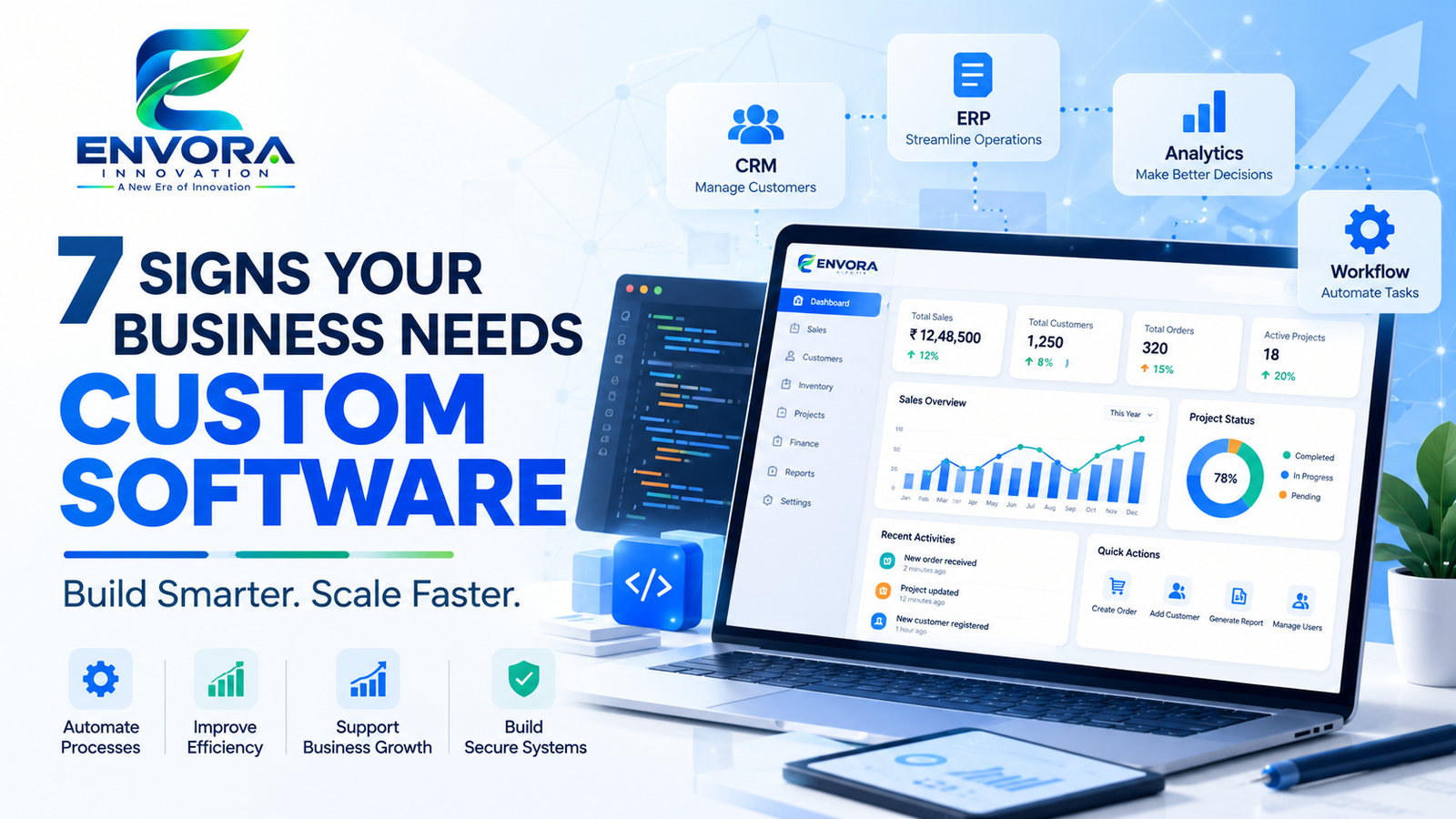
Signs Your Business Needs Custom Software Development in 2026
Running a business in 2026 requires efficient processes, reliable technology, and software that supports growth. Many businesses start with spreadsheets and ready-made applications, but as operations expand, managing everything manually becomes increasingly difficult.
Employees may spend hours entering data, teams may struggle to share information, and business owners may find it difficult to track performance.
This is where custom software development can help.
Custom software is designed around your business requirements, workflows, and long-term objectives. Instead of forcing your team to adapt to the limitations of generic applications, you can build a solution that fits the way your business operates.
But how do you know when it is time to invest in custom software?
Here are seven signs that your business may benefit from a customized software solution.
1. Your Team Spends Too Much Time on Manual Tasks
One of the first signs that your business needs better software is the amount of time employees spend on repetitive tasks.
For example, your team might manually:
- Enter customer information into multiple systems.
- Prepare daily or monthly reports.
- Update inventory records.
- Generate invoices.
- Send payment reminders.
- Track employee attendance.
- Copy information between spreadsheets.
These activities can consume valuable time and increase the possibility of human error.
How Custom Software Can Help
A customized business application can automate suitable repetitive tasks and connect related processes.
For example, when a customer places an order, the system could automatically update inventory, generate an invoice, notify the relevant team, and record the transaction.
Business benefit: Reduced repetitive work, more consistent processes, and more time for activities that support business growth.
2. Your Business Uses Too Many Disconnected Applications
Many businesses use separate applications for accounting, customer management, inventory, sales, employee records, and reporting.
Although each application may serve a purpose, switching between multiple systems can create operational challenges.
Your sales team might maintain one customer record, while your accounts department maintains another. Inventory information may be updated separately, making it difficult to get an accurate overview of operations.
How Custom Software Can Help
Custom software can bring important business functions into one connected platform.
Depending on your requirements, this platform could include:
- Customer Relationship Management (CRM).
- Inventory and stock management.
- Sales and order management.
- Employee management.
- Reporting and analytics.
- Role-based access control.
- Third-party API integrations.
Instead of maintaining disconnected workflows, employees can access relevant information through a centralized system.
Business benefit: Better coordination, improved visibility, and reduced duplication of work.
3. Ready-Made Software Does Not Meet Your Requirements
Ready-made software is often an excellent choice when your business needs standard features.
However, some companies have specialized workflows that generic applications cannot support efficiently.
For example, a logistics company might need customized vehicle allocation, delivery tracking, driver management, customer notifications, and operational reporting.
A manufacturing business may require specific production workflows, inventory rules, and approval processes.
If your team constantly changes its processes to accommodate software limitations, it may be worth evaluating a custom solution.
How Custom Software Can Help
Custom software development allows you to define features according to your actual requirements.
You can plan:
- Business-specific workflows.
- Custom dashboards.
- Specialized reports.
- Approval hierarchies.
- Department-specific permissions.
- Industry-specific modules.
- Integrations with existing systems.
Business benefit: Software that better matches your operations and can evolve as your requirements change.
4. Your Business Is Growing, but Your Systems Cannot Keep Up
Growth is exciting, but it can expose weaknesses in existing processes.
A spreadsheet that works for 20 customers may become difficult to maintain when you have thousands of customer records.
A manual inventory process may become unreliable when you operate across several locations.
Similarly, managing multiple branches through separate systems can make reporting and coordination more complicated.
How Custom Software Can Help
A scalable software solution can be designed around your current needs and anticipated growth.
Depending on the project, this may involve:
- Modular application architecture.
- Database optimization.
- API-based integrations.
- Multi-branch management.
- Centralized reporting.
- User and permission management.
- Cloud deployment options.
Scalability requires appropriate architecture, testing, and infrastructure planning. It does not happen automatically simply because software is custom-built.
Business benefit: A technology foundation that can support increasing operational complexity.
5. You Cannot Get Accurate Business Reports Quickly
Business decisions depend on reliable information.
However, if your team collects information from multiple spreadsheets and applications, preparing reports can become a time-consuming process.
You might struggle to answer important questions:
- Which products generate the most revenue?
- How much inventory is available?
- Which sales opportunities require attention?
- How many orders are pending?
- Which departments are meeting their targets?
- What are the current operational bottlenecks?
Without timely information, identifying problems and making informed decisions becomes more difficult.
How Custom Software Can Help
A business management application can consolidate relevant information into dashboards and reports.
Depending on the system, features may include:
- Real-time or scheduled reporting.
- Sales and inventory dashboards.
- Performance indicators.
- Exportable reports.
- Automated notifications.
- Historical data analysis.
Reports should be based on accurate, appropriately maintained source data.
Business benefit: Better visibility into business operations and faster access to useful information.
6. Your Business Needs Better Security and Access Control
As businesses grow, more employees, departments, and external partners may need access to business applications.
Giving everyone unrestricted access to the same information can create security and operational risks.
For example, employees who manage inventory may not need access to confidential financial reports. A department manager may need to approve requests without having access to every administrative function.
How Custom Software Can Help
A properly designed application can implement Role-Based Access Control (RBAC) and other security measures.
These may include:
- Role-specific permissions.
- Secure authentication.
- Access restrictions for sensitive information.
- Activity logs and audit trails.
- Data validation.
- Backup and recovery procedures.
- Appropriate API security controls.
Security also depends on implementation quality, infrastructure, maintenance, and operational practices.
Business benefit: More controlled access to business information and better alignment between permissions and responsibilities.
7. Your Business Needs to Integrate Different Systems
Businesses often depend on multiple platforms to manage payments, customer communication, shipping, accounting, and internal operations.
When these systems do not communicate effectively, employees may need to transfer information manually.
For example, an e-commerce business might need its website to communicate with inventory software, a payment gateway, a shipping provider, and an invoicing system.
How Custom Software Can Help
Custom applications and API integrations can connect compatible systems and automate information exchange.
Possible integrations include:
- Payment gateways.
- Email and SMS services.
- Shipping and logistics platforms.
- Accounting applications.
- CRM and ERP systems.
- Third-party business APIs.
- Mobile applications.
Integration feasibility depends on the APIs, permissions, documentation, and technical limitations of the systems involved.
Business benefit: Better-connected workflows and less manual coordination between applications.
Custom Software vs. Ready-Made Software: Which Should You Choose?
Not every business needs custom software. The right choice depends on your requirements, budget, available resources, and expected growth.
| Factor | Ready-Made Software | Custom Software |
|---|---|---|
| Initial implementation | Often faster | Requires planning and development |
| Initial cost | Often lower | Can be higher |
| Customization | Depends on the product | Designed around agreed requirements |
| Business workflows | Uses supported workflows | Can accommodate specialized workflows |
| Integrations | Depends on available integrations | Can be developed for supported systems |
| Maintenance | Depends on the vendor's model | Depends on the support arrangement |
| Ownership and licensing | Governed by vendor terms | Depends on the development contract |
| Best suited for | Standard business requirements | Specialized requirements and workflows |
When Should You Choose Ready-Made Software?
Consider ready-made software when:
- Your requirements are standard.
- An existing product already provides the features you need.
- You want to minimize initial development work.
- Its integrations and licensing terms meet your requirements.
When Should You Consider Custom Software?
Consider custom development when:
- Your business has specialized workflows.
- Existing software cannot meet important requirements.
- You need integrations between multiple systems.
- Your business requires specific access controls or reporting.
- You want greater control over future feature development.
Before making a decision, compare the total cost of ownership, including implementation, subscriptions, integrations, maintenance, training, and future changes.
How Much Does Custom Software Development Cost in India?
The cost of custom software development depends on the project's scope, complexity, technology stack, integrations, security requirements, and development timeline.
For example, a basic internal business application will generally require a different investment from a comprehensive ERP platform with multiple departments, complex approval workflows, and third-party integrations.
The following factors can affect the final cost:
1. Project Scope: The number of modules, screens, and workflows.
2. Technical Complexity: Business rules, integrations, and data processing requirements.
3. User Experience: Interface design, accessibility, and responsive layouts.
4. Security Requirements: Authentication, permissions, auditing, and compliance needs.
5. Infrastructure: Hosting, databases, backups, and deployment.
6. Ongoing Maintenance: Bug fixes, security updates, monitoring, and future enhancements.
The most reliable way to estimate costs is to define the required features and request a project-specific proposal.
Why Choose Envora Innovation for Custom Software Development?
At Envora Innovation, we focus on developing digital solutions around business requirements and operational objectives.
Our services include:
- Custom software development.
- Website and web application development.
- ERP software development.
- CRM solutions.
- E-commerce development.
- API development and integration.
- Mobile application development.
- UI/UX design.
Whether you are building a new business application, modernizing an existing system, or connecting different business tools, choosing the right development approach is an important first step.
A successful project begins with understanding the problem, defining requirements, selecting appropriate technologies, and planning for testing and maintenance.
Our goal is to help businesses explore practical digital solutions that align with their needs and future plans.
Visit Envora Innovation to learn more about our services and discuss your project requirements.
Conclusion
Custom software development can help businesses address operational challenges that standard tools may not solve effectively.
If your team spends too much time on manual tasks, struggles with disconnected applications, needs specialized workflows, or cannot access reliable business reports, it may be time to review your current software strategy.
However, custom development is not always the answer. The best solution is the one that meets your requirements while balancing cost, reliability, usability, and long-term maintenance.
Start by identifying your biggest operational challenge and evaluating whether existing tools can solve it.
If they cannot, a customized software solution may be worth considering.
Ready to build software around your business needs?
Contact Envora Innovation to discuss your software development, ERP, CRM, or web application requirements.
Frequently Asked Questions (FAQs)
What is custom software development?
Custom software development is the process of designing, building, testing, and maintaining software for specific business requirements, workflows, and users.
Is custom software suitable for small businesses?
Yes. Small businesses can benefit from custom software when their operational requirements justify the development and maintenance costs. However, ready-made software may be more economical for standard needs.
How long does custom software development take?
The timeline depends on the project's scope, complexity, integrations, testing requirements, and available resources. A small application may take considerably less time than a complex enterprise platform.
Is custom software more expensive than ready-made software?
Custom software often requires a larger initial investment, but the overall cost depends on implementation, licensing, maintenance, integrations, and future requirements. Both options should be evaluated over their expected useful life.
Can custom software integrate with existing applications?
Yes, where suitable APIs or other supported integration methods are available. The feasibility and cost depend on the existing systems and their technical limitations.
What industries can benefit from custom software?
Industries such as logistics, education, retail, manufacturing, real estate, and professional services may benefit from software designed around their specific workflows. Requirements and regulatory obligations vary by industry.