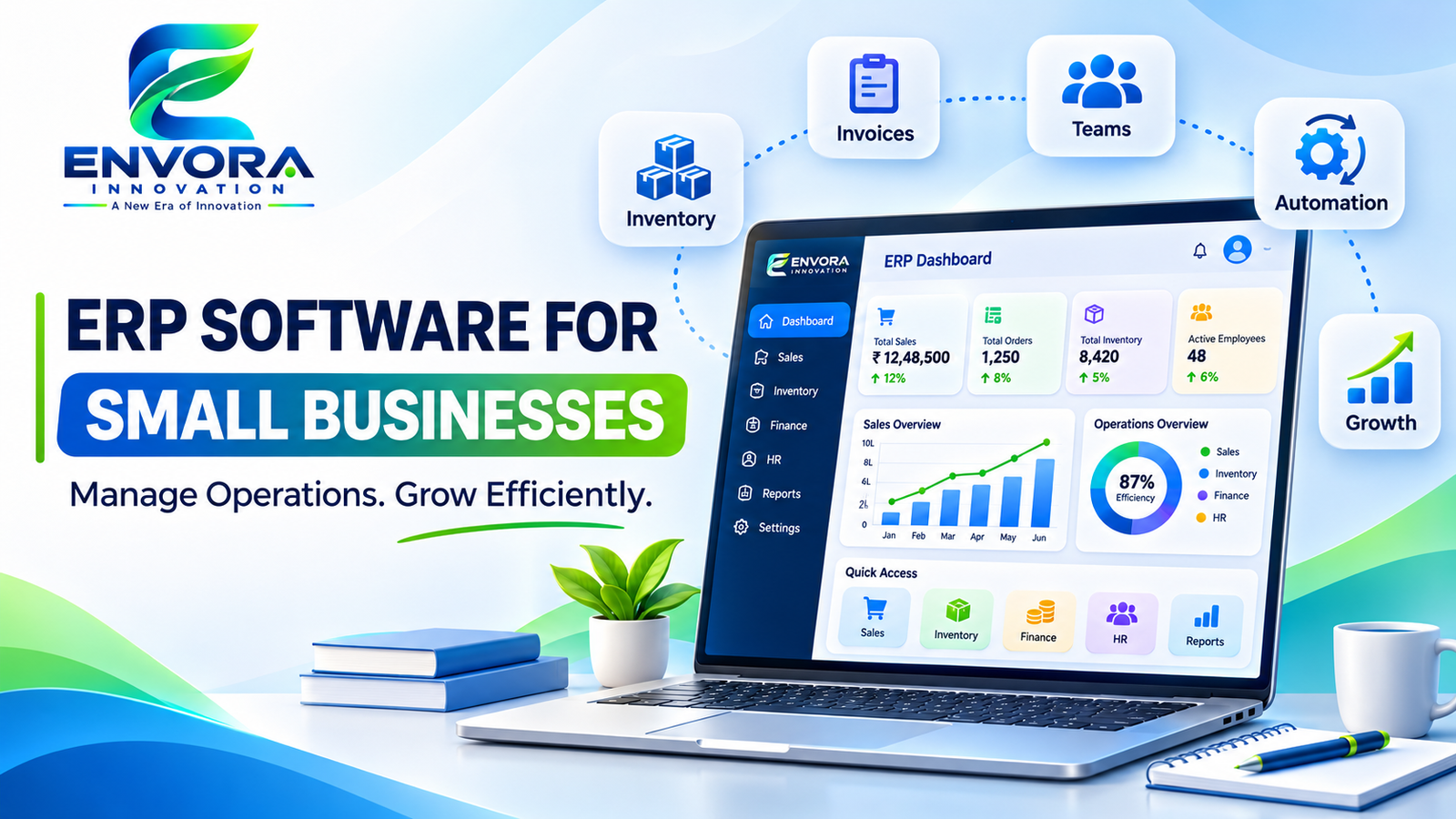
How ERP Software Helps Small Businesses Manage Operations Efficiently
Running a small business involves managing multiple responsibilities, including sales, inventory, accounting, employees, customer relationships, and daily operations. As a business grows, handling these activities through spreadsheets, separate applications, and manual processes becomes increasingly difficult.
This is where ERP (Enterprise Resource Planning) software can make a significant difference.
ERP software brings different business functions together into one centralized system, helping small businesses improve efficiency, reduce operational complexity, and make better decisions.
In this guide, we will explore how ERP software helps small businesses manage operations efficiently and why investing in the right ERP solution can support long-term growth.
What Is ERP Software?
ERP stands for Enterprise Resource Planning. It is a business management system that integrates multiple operational processes into a single platform.
Instead of using separate tools for inventory, accounting, sales, purchasing, and employee management, businesses can manage these activities through a centralized ERP system.
A typical ERP system may include:
- Inventory and warehouse management
- Sales and order management
- Purchase and supplier management
- Accounting and financial reporting
- Employee and HR management
- Customer relationship management (CRM)
- Project and task management
- Business analytics and reporting
With centralized information, business owners and employees can access accurate data and coordinate operations more effectively.
1. Centralized Business Management
One of the biggest advantages of ERP software is centralized business management.
Small businesses often maintain information across multiple spreadsheets, applications, and documents. This creates confusion, duplicate entries, and difficulties in tracking business performance.
ERP software brings important business information into one platform.
For example, when a sales order is created, the system can connect the order with inventory availability, customer information, and financial records.
This centralized approach helps businesses:
- Maintain consistent business information
- Reduce duplicate data entry
- Improve communication between departments
- Access important information quickly
- Maintain better operational control
2. Improved Inventory Management
Inventory management is essential for businesses dealing with products, manufacturing, distribution, or retail.
Without proper inventory tracking, businesses may experience stock shortages, excess inventory, delayed deliveries, and unnecessary purchasing expenses.
ERP software helps businesses monitor inventory levels in real time and maintain better control over stock movement.
Key inventory management capabilities include:
- Real-time stock tracking
- Stock movement management
- Low-stock alerts
- Purchase planning
- Warehouse management
- Product and category management
- Inventory reports
By improving inventory visibility, businesses can reduce stock-related problems and make more informed purchasing decisions.
3. Better Financial Management
Financial management becomes more complicated as a business grows.
ERP software can help businesses manage financial information, track expenses, monitor revenue, and generate useful financial reports.
Depending on the ERP configuration, financial features may include:
- Expense tracking
- Invoice management
- Payment tracking
- Accounts receivable
- Accounts payable
- Profit and loss reporting
- Financial dashboards
Having financial information in one system allows business owners to understand their financial position more clearly.
It also helps reduce manual reporting and improve financial transparency.
4. Automation of Repetitive Business Processes
Many small businesses spend significant time performing repetitive administrative tasks.
Examples include preparing invoices, updating inventory records, generating reports, tracking payments, and sending reminders.
ERP software can automate several of these activities.
For example:
- Automatically update inventory after sales transactions.
- Generate invoices from confirmed orders.
- Send notifications for pending payments.
- Trigger low-stock alerts.
- Generate scheduled business reports.
- Streamline approval workflows.
Business process automation reduces unnecessary manual work and allows employees to focus on more valuable activities.
5. Enhanced Customer Relationship Management
Customer satisfaction plays an important role in business growth.
ERP software with integrated CRM capabilities helps businesses maintain customer information, track interactions, manage enquiries, and monitor sales opportunities.
Businesses can use customer management features to:
- Maintain customer profiles
- Track enquiry history
- Manage sales leads
- Monitor customer orders
- Improve follow-up processes
- Maintain communication records
Better customer information helps businesses deliver more consistent service and build stronger customer relationships.
6. Improved Employee Productivity
When employees use different tools to manage daily responsibilities, productivity can suffer.
ERP software provides a structured working environment where employees can access relevant information, manage assigned tasks, and coordinate with other teams.
Depending on the system, employee productivity features may include:
- Task assignment and tracking
- Attendance management
- Leave management
- Employee records
- Department-wise workflows
- Performance reporting
By reducing administrative complexity, ERP software helps employees complete their responsibilities more efficiently.
7. Real-Time Business Reports and Analytics
Business owners need accurate information to make effective decisions.
ERP software provides dashboards and reports that help businesses monitor important performance indicators.
Common business insights include:
- Total sales and revenue
- Inventory availability
- Outstanding payments
- Business expenses
- Customer performance
- Sales trends
- Operational performance
Instead of manually collecting data from multiple sources, business owners can access consolidated reports and identify areas that require attention.
Data-driven decision-making helps businesses plan more effectively and respond to changing business conditions.
8. Reduced Operational Costs
ERP software can help small businesses reduce unnecessary operational expenses by improving efficiency and visibility.
Potential cost-saving opportunities include:
- Reduced manual administrative work
- Better inventory control
- Fewer data entry errors
- Improved purchasing decisions
- More efficient employee workflows
- Reduced reporting effort
The actual savings depend on business size, ERP implementation, and how effectively the system is used.
9. Scalability for Growing Businesses
A business management system should support future growth rather than create additional limitations.
As a business expands, it may need additional users, departments, warehouses, branches, or operational modules.
A scalable ERP solution allows businesses to expand their capabilities as requirements change.
Businesses can start with essential modules and gradually introduce additional functionality.
This approach helps small businesses adopt technology according to their current needs while preparing for future growth.
10. Why Custom ERP Software Can Be a Better Choice
Ready-made ERP software can be suitable for businesses with standard operational requirements.
However, some businesses have unique workflows, industry-specific processes, or specialized reporting requirements.
Custom ERP software allows businesses to build functionality around their actual operational needs.
With custom ERP development, businesses can:
- Create customized business workflows
- Develop industry-specific modules
- Integrate existing applications
- Configure role-based access control
- Build custom dashboards and reports
- Scale functionality according to business requirements
A properly planned custom ERP solution can help businesses maintain greater flexibility and operational control.
How to Choose the Right ERP Software for Your Small Business
Before selecting an ERP system, businesses should evaluate their operational requirements carefully.
Consider the following factors:
- Business requirements: Identify the processes that need improvement.
- Essential modules: Select the modules required for daily operations.
- Ease of use: Choose software that employees can learn and use comfortably.
- Scalability: Ensure the system can support future business growth.
- Integration capabilities: Check whether the ERP can connect with existing business applications.
- Security: Evaluate user permissions, data protection, and access controls.
- Implementation cost: Consider development, licensing, training, and maintenance expenses.
- Support and maintenance: Ensure reliable technical support is available.
Choosing ERP software based on actual business requirements can help maximize its long-term value.
Conclusion
ERP software is no longer limited to large enterprises. Small businesses can also benefit from centralized management, improved inventory control, automated workflows, better financial visibility, and more efficient operations.
The right ERP system helps businesses reduce operational complexity, improve productivity, and establish a stronger foundation for growth.
Whether you choose a ready-made ERP solution or custom ERP software, the most important factor is selecting a system that aligns with your business processes and future objectives.
Build Smarter Business Operations with Envora Innovations
At Envora Innovations, we help businesses transform their operations through custom software development, business automation, and tailored digital solutions.
Our development services can help businesses create scalable management systems designed around their specific requirements.
If you are planning to streamline your business operations with a customized ERP solution, explore our software development services and discover how technology can support your business growth.
Ready to improve your business operations? Contact Envora Innovations to discuss your software development requirements.