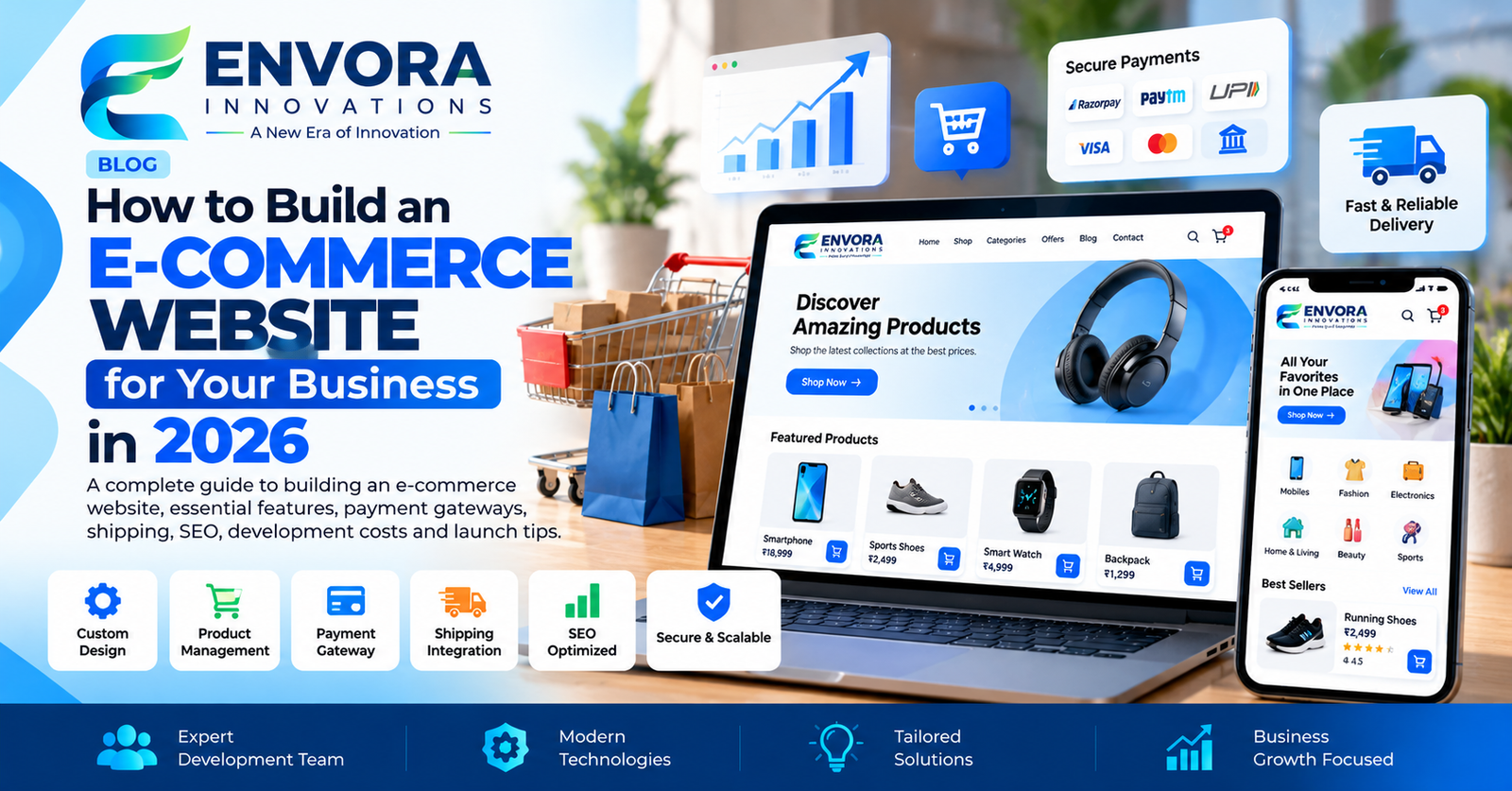
How to Build an E-commerce Website for Your Business in 2026
Want to sell your products online and reach more customers? Building an e-commerce website can help your business showcase products, accept orders, process payments and manage sales from one place.
Whether you run a small retail shop, a clothing brand, a food business or a growing company, the right online store can make it easier for customers to discover and purchase your products.
In this guide, Envora Innovations explains how to build an e-commerce website, which features to include, how to select a platform and what to consider before launching your online store.
What Is an E-commerce Website?
An e-commerce website is an online platform where customers can browse products or services and place orders over the internet.
A typical online store includes product listings, product details, a shopping cart, checkout, payment options and order management.
Depending on the business model, it may also include inventory management, shipping integrations, discount codes, customer accounts and sales reports.
1. Define Your Business Requirements
Before starting e-commerce website development, identify what you want your store to achieve.
Consider these questions:
- What products or services will you sell?
- How many products will you list initially?
- Will you sell directly to customers or to other businesses?
- Will you deliver locally, nationally or internationally?
- Do you need cash on delivery, online payments or both?
- Will you manage orders yourself or connect a fulfilment partner?
Clear requirements help you choose suitable technology and avoid paying for features you do not currently need.
2. Choose the Right E-commerce Platform
Your platform affects your initial development cost, flexibility, maintenance and future expansion.
Shopify
Shopify is a hosted e-commerce platform that provides store management tools, themes and integrations. It can be useful for businesses that want a managed solution and prefer not to maintain their own server infrastructure.
Consider its recurring subscription and app costs when planning your budget.
WooCommerce
WooCommerce adds e-commerce functionality to WordPress. It can suit businesses that want control over their website and content, although hosting, updates, plugins and security need to be managed.
Custom E-commerce Development
A custom-developed store can be built around your specific business processes. For example, a Laravel-based platform can include customised product management, order workflows, customer roles, APIs and integrations.
Custom development is particularly worth evaluating when standard platforms cannot meet important business requirements.
Tip: Compare platforms based on your requirements, total ownership cost, support and future plans rather than choosing only by popularity.
3. Design a User-Friendly Online Store
Your website should make it easy for customers to find products and complete purchases.
Important pages include:
- Home page
- Product category pages
- Product detail pages
- Shopping cart
- Checkout
- About Us
- Contact Us
- Shipping and return policies
- Privacy policy and terms
Use clear navigation, readable product information, consistent branding and high-quality product photographs.
The website should also work smoothly on mobile phones, since customers may discover and purchase products through mobile devices.
4. Add Essential E-commerce Features
A functional online store needs more than an attractive design.
Product catalogue
Organise products into categories and include names, descriptions, prices, images, variants and stock availability.
Shopping cart
Allow customers to review selected products, change quantities and see the order total before checkout.
Secure checkout
Keep the checkout process simple. Display shipping charges, taxes where applicable and the final amount clearly before the customer confirms the order.
Payment gateway
Integrate a suitable payment provider to accept supported payment methods such as UPI, cards and net banking. Availability depends on the provider and your merchant account.
Order management
Provide tools to review orders, update order statuses, manage cancellations and process refunds according to your policies.
Inventory management
Track available stock and update inventory when orders are placed or cancelled. Larger stores may need bulk imports or integration with existing business software.
Notifications
Order confirmations, shipping updates and other transactional messages help customers understand what happens after a purchase.
5. Integrate Shipping and Delivery
Delivery is an important part of the online shopping experience.
Before launch, decide how you will calculate shipping charges, print labels, share tracking details and manage returns.
You can handle deliveries directly or evaluate shipping providers and aggregators based on their serviceable locations, rates, pickup options, tracking and return processes.
Make your estimated delivery times and shipping policies easy to find. Do not promise delivery dates that your fulfilment process cannot reliably meet.
6. Make Your E-commerce Website SEO-Friendly
Search engine optimisation helps potential customers discover your products through relevant searches.
Start with these practices:
- Write unique product titles and descriptions.
- Use descriptive URLs for products and categories.
- Add meaningful alternative text to product images.
- Create useful category pages.
- Use canonical URLs correctly where duplicate product URLs exist.
- Submit your sitemap to Google Search Console.
- Improve mobile usability and page performance.
- Add relevant internal links between categories, products and guides.
- Use appropriate structured data and validate it.
Avoid copying identical descriptions across many products or stuffing pages with repeated keywords. Focus on accurate information that helps customers make a decision.
7. Understand the Cost of E-commerce Website Development
The cost of e-commerce website development in India varies with the platform, product catalogue, design, integrations and amount of custom functionality.
Illustrative planning ranges include:
- Starter online store: approximately ₹30,000–₹80,000
- Professional store with additional customisation: approximately ₹80,000–₹2,00,000
- Custom e-commerce platform: approximately ₹2,00,000 and above
These are broad estimates, not fixed prices or a quotation from Envora Innovations. Actual costs may fall outside these ranges.
Other expenses can include domain registration, hosting, platform subscriptions, premium themes or plugins, product photography, payment processing, shipping, maintenance and marketing.
Request a written quotation that clearly lists included features, exclusions, delivery milestones and ongoing charges.
8. Secure Your Online Store
Customers need confidence that their information and orders are handled responsibly.
Use HTTPS, strong administrator passwords, role-based access, regular backups and maintained software dependencies.
Collect only the information you need, restrict access to customer data and use a reputable payment provider rather than storing sensitive card details yourself.
Test checkout, payment confirmation, order notifications, refunds and failed-payment scenarios before accepting real orders.
9. Test Before Launching
Before making the store public, test the complete buying journey.
Check that:
- Product prices and stock are correct.
- Product images and descriptions display properly.
- Cart quantities and totals update correctly.
- Successful and failed payments are handled properly.
- Order confirmations reach the appropriate recipients.
- Shipping charges and delivery information are accurate.
- The site works on mobile and desktop.
- Important pages and contact forms work.
- Backups and administrator access are configured.
A small, controlled test order can help identify issues that are easy to miss during development.
10. Promote Your Online Store After Launch
Launching your website is only the beginning. Customers need ways to discover your products.
Depending on your audience and budget, you can use SEO, useful blog articles, social media, email marketing, paid advertising and eligible business listings.
Track meaningful metrics such as product views, add-to-cart activity, completed orders, checkout abandonment and repeat purchases. Use the findings to improve product pages and the shopping journey.
Frequently Asked Questions
How much does it cost to build an e-commerce website in India?
The cost depends on the platform, features, catalogue size and integrations. A basic store may fit within a budget of tens of thousands of rupees, while customised and enterprise platforms can require several lakhs or more.
Can a small business start selling online with a simple website?
Yes. A small business can start with a manageable product catalogue, essential payment options, clear shipping policies and basic order management. Additional features can be introduced as the business grows.
Which is better: Shopify, WooCommerce or custom development?
Shopify offers a managed platform, WooCommerce offers WordPress-based flexibility, and custom development offers greater control over specialised workflows. The right choice depends on the business requirements, budget and ongoing maintenance capacity.
Do I need a payment gateway?
If you want to accept online payments, you generally need a suitable payment provider or platform-supported checkout solution. You should also decide whether to offer cash on delivery where practical.
How long does e-commerce website development take?
A straightforward store may take a few weeks, while a customised platform with complex integrations can take longer. Product readiness, approvals and third-party integrations also affect the timeline.
Conclusion
Building an e-commerce website involves more than adding products to a page. A successful store combines a suitable platform, clear product information, a convenient checkout, reliable delivery processes, security and ongoing optimisation.
Start with your business goals, prioritise essential features and choose a solution that fits your budget and future plans.
Build Your Online Store with Envora Innovations
Looking to launch an online store or upgrade your existing e-commerce platform?
Envora Innovations can help you explore website development, e-commerce functionality and custom software solutions based on your business requirements.
Ready to discuss your project? Visit Envora Innovations and share your requirements to begin planning your online store.
Pricing figures are illustrative estimates for planning purposes. Confirm current platform, hosting, payment and development charges before making a purchase decision.