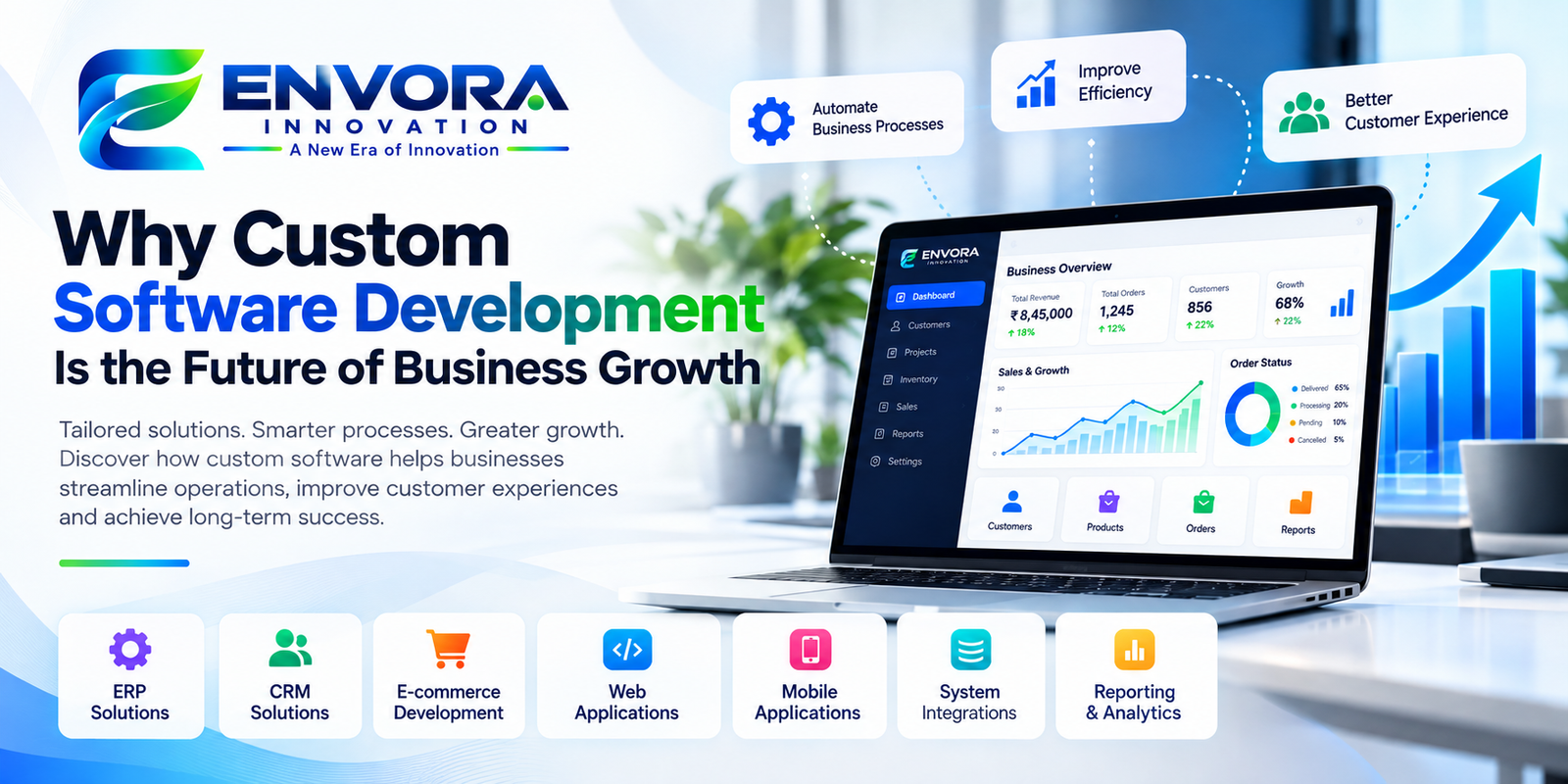
Why Custom Software Development Is the Future of Business Growth
Businesses today are increasingly using technology to manage operations, improve customer experiences and make better decisions. While ready-made software can be useful for common business needs, many growing companies eventually need solutions designed around their own processes. This is where custom software development becomes valuable.
Custom software is developed specifically for a business, its workflows, users and objectives. Instead of changing your business processes to fit a standard application, custom software allows technology to be designed around the way your business actually works
What Is Custom Software Development?
Custom software development is the process of designing and building software according to the specific requirements of a business or organization.
A custom solution can include features such as:
- Business process automation
- ERP and business management systems
- CRM platforms
- E-commerce applications
- Web applications
- Mobile applications
- Customer portals
- Employee management systems
- Inventory management
- Reporting and analytics
- Third-party integrations
The exact features depend on the organization's requirements, industry and growth plans.
Why Are Businesses Choosing Custom Software?
Every business operates differently. Two companies in the same industry may have completely different workflows, customer processes and operational requirements.
A standard software product may provide many useful features, but businesses may still encounter limitations when they need specific functionality.
Custom software can help address these requirements by providing a solution built around the organization's actual processes.
1. Software Designed Around Your Business
One of the biggest advantages of custom software is flexibility.
Instead of adapting your workflow to an existing application, developers can design the system around your business processes.
For example, a company may require a customized workflow connecting sales, inventory, accounting and customer management. A custom application can bring these processes together according to the company's requirements.
2. Better Business Process Automation
Many businesses still depend on repetitive manual tasks such as entering information, preparing reports, updating records and transferring data between different systems.
Custom software can automate suitable processes and reduce unnecessary manual work.
Automation can help teams:
- Reduce repetitive tasks
- Organize information
- Improve workflow consistency
- Reduce manual data entry
- Access information faster
- Spend more time on important business activities
3. Integration With Existing Systems
Modern businesses often use multiple tools for different functions.
For example, a business might use separate systems for:
- Accounting
- Customer
- management Inventory
- Payments
- Marketing
- Sales
- Communication
Custom software can be developed with integrations that allow different systems to exchange relevant information.
This can help create a more connected technology environment instead of forcing employees to repeatedly enter the same information into different applications.
4. Scalability for Future Growth
Business requirements change as a company grows.
A small business may initially need a simple application, while a growing organization may later require additional users, locations, workflows, reports or integrations.
A well-planned custom software solution can be developed with future expansion in mind.
This means businesses can add or modify functionality as their requirements evolve.
5. Better User Experience
Software should be easy for its intended users to understand and operate.
Custom applications can be designed according to the specific needs of employees, administrators, customers or other users.
For example, a customer portal can be designed around the actions customers actually need, while an internal dashboard can focus on the information employees use every day.
A simpler user experience can make technology easier to adopt across an organization.
Custom Software vs Ready-Made Software
Both custom and ready-made software can be useful. The right choice depends on the business requirements.
Ready-made software can be suitable when a business needs common features and wants to start using a solution quickly.
Custom software can be considered when a business requires:
- Unique workflows
- Specialized functionality
- Multiple system integrations
- Specific reporting requirements
- Customized user roles
- Business-specific automation
- A solution that can evolve with the organization
The decision should be based on the actual requirements, budget, timeline and long-term technology plans of the business.
How Custom Software Supports Business Growth
Technology should do more than simply digitize existing processes. It should help businesses work more efficiently and provide better experiences to customers and employees.
A properly planned software solution can bring important business functions into a structured digital environment.
For example, a growing company could use a combination of:
CRM + ERP + E-Commerce + Mobile Application + Business Analytics
to manage different aspects of its operations.
The systems can be designed to work together where appropriate, creating a more connected digital ecosystem.
Custom Software for Different Industries
Custom software can be developed for many types of businesses.
Examples include:
- Retail businesses
- E-commerce companies
- Manufacturing organizations
- Education businesses
- Healthcare organizations
- Logistics companies
- Real estate businesses
- Service companies
- Start ups
- Professional organizations
The technology can be adapted according to the processes and requirements of each organization.
What Does Custom Software Development Include?
A professional software development process usually involves multiple stages.
Requirement Analysis
The first step is understanding the business, users, existing processes and desired outcomes.
Planning
The development team defines the features, technology, workflows and overall project structure.
UI/UX Design
The user interface and experience are planned to make the software practical and easy to use.
Development
Developers build the required functionality according to the approved requirements.
Testing
The application is tested to identify functional issues, usability problems and other technical concerns.
Deployment
Once the solution is ready, it can be deployed to the appropriate environment.
Maintenance and Improvements
Software may require updates, improvements, security maintenance and new features as business requirements change.
How to Choose a Custom Software Development Company
Choosing a development partner is an important part of a software project.
Businesses should consider factors such as:
- Relevant development experience
- Understanding of business requirements
- Technology expertise
- Development methodology
- Communication process
- Testing practices
- Post-development support
- Scalability of solutions
- Project transparency
A good development process starts with understanding the business problem rather than immediately writing code.
The Future of Business Software
As businesses become increasingly digital, software is becoming an important part of everyday operations.
Organizations are using technologies such as cloud applications, automation, analytics, artificial intelligence and mobile platforms to improve the way they operate.
Custom software can help businesses combine these technologies into solutions that match their specific requirements.
The goal is not simply to build more software. The goal is to build useful technology that solves real business problems.
Conclusion
Custom software development gives businesses the flexibility to build technology around their specific requirements. From ERP and CRM systems to e-commerce platforms, web applications and mobile apps, custom solutions can support businesses across different stages of growth.
At Envora Innovation, we provide software development services and also work on digital software products designed to address real business needs. Our solutions can be tailored to business requirements, workflows and growth objectives.
Whether a business needs a custom software solution, ERP, CRM, e-commerce platform, website, web application or mobile application, the right technology approach can help create a more organized and scalable digital environment.
Frequently Asked Questions
What is custom software development?
Custom software development is the process of creating software specifically according to the requirements, workflows and objectives of a business.
Is custom software better than ready-made software?
Neither option is universally suitable. The right choice depends on the business's requirements, budget, timeline, integrations and long-term goals.
Can custom software integrate with existing systems?
Yes. Custom applications can be designed to integrate with suitable existing systems, APIs and third-party services.
Can custom software be expanded later?
A well-planned software solution can be designed with scalability in mind, allowing new features, users, workflows and integrations to be added as requirements evolve.
What types of software does Envora Innovation develop?
Envora Innovation provides custom software development along with ERP, CRM, e-commerce, web development and mobile application solutions, and also develops software products for business needs.